Simon Laveuve (1988, Paris)
French artist.
Sculpture, photography, installation.
Lives and works in the Paris region, France.
▌The Territory as a Starting Point
Born in Paris in 1988 and raised in the suburbs of the French capital, where he still lives today, Simon Laveuve grew up in the shadow of the post-war Brutalist architectures designed by Renée Gailhoustet and Jean Renaudie, which profoundly shaped his imagination. Surrounded by housing estates, tower blocks and industrial zones, he developed an early awareness of a form of urbanism that was both constrained and functional, yet also driven by utopian ambitions.
This formative environment continues to inform his artistic universe and has fostered an intimate relationship with the city, where notions of dwelling, survival and collective memory remain central concerns.
⁂
▌The Photographic Gaze
Laveuve began his career in photography in 2008. At the age of twenty, he started working as a professional photographer specializing in portraiture and still life. He collaborated with publishers and commercial brands while developing an extensive activity within the music industry, producing portraits, album artwork and music videos.
This practice profoundly shaped his way of seeing. Through photography, he developed a particular sensitivity to light, framing, detail and narrative, but also to the ways individuals inhabit and appropriate their surroundings. Long before turning to sculpture, questions of territory, memory and the relationship between people and their environment already occupied a central place in his work.
Today, this experience forms the foundation of his artistic practice.
⁂
▌Sculpture as an Extension
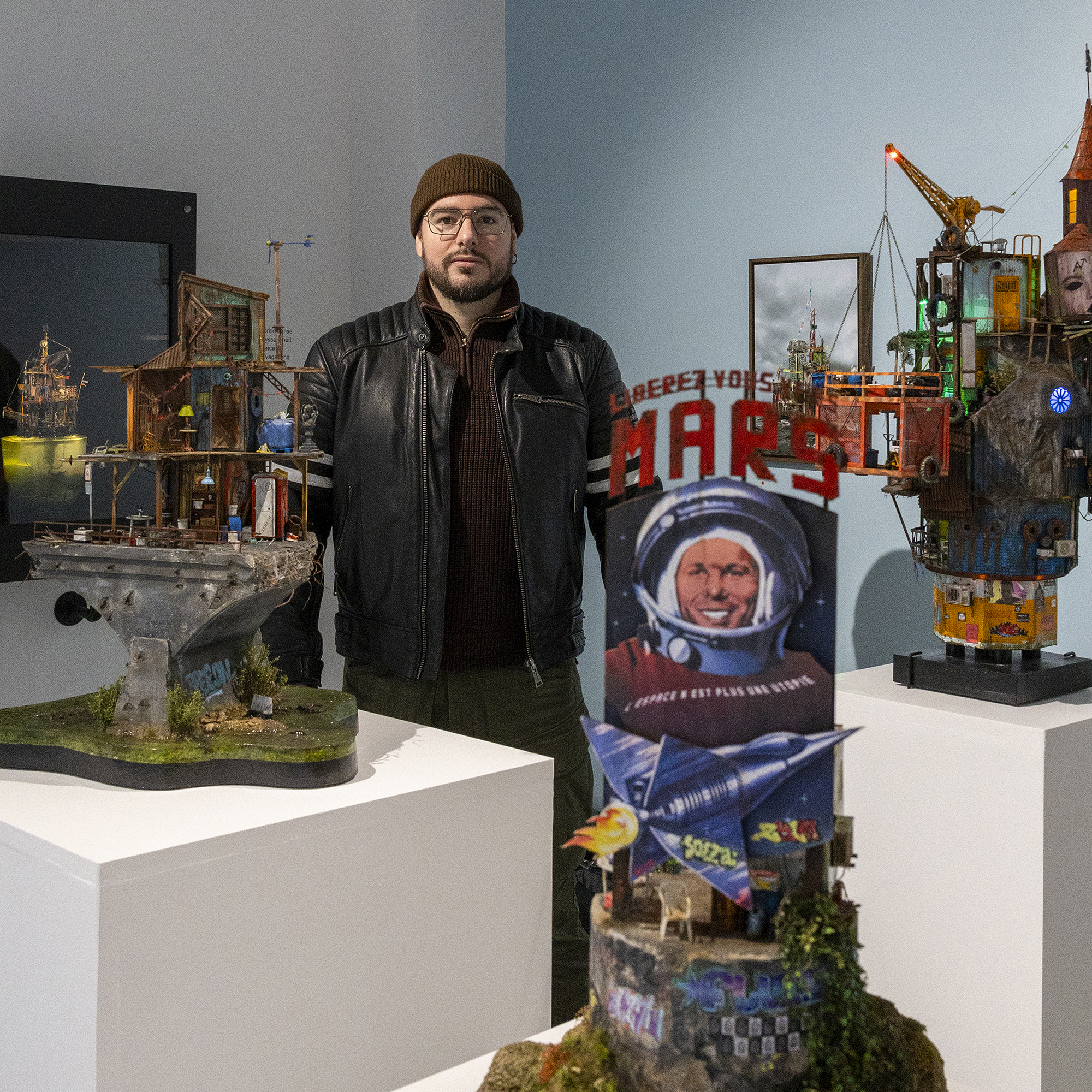
In 2016, Laveuve began translating his photographic vision into a self-taught sculptural practice, assembling miniature constructions that take the form of hybrid architectures, suspended between improvised shelters and imaginary refuges.
For him, miniature scale is not merely a question of size. It engages with the tradition of trompe-l’œil and deliberately blurs the boundaries between sculpture, set design and image. Created primarily at a 1:35 scale, his dioramas invite viewers to question what they are seeing, oscillating between realistic illusion and poetic fiction.
Each work becomes a fragment of a larger territory, later documented through photography, where precarious dwellings, weathered lighthouses, makeshift cabins, graffiti-covered guard posts and vegetation-covered towers coexist.
His universe unfolds within a fragile balance between ruin and renewal, humour and desolation, abandonment and resilience. Often inaccessible, these micro-architectures appear as places of survival whose purpose remains deliberately uncertain. Through them, Laveuve explores height, fragility and the very notion of inhabiting space, constructing environments that function simultaneously as testimony, projection and mirage.
⁂
▌Poetic Chaos
His materials are intentionally modest: salvaged components, repurposed objects and industrial or domestic leftovers. Through recycling and the transformation of discarded materials, Laveuve develops an aesthetic rooted in improvisation, craftsmanship and self-teaching, standing in contrast to standardized systems of production and consumption.
His sculptures abound with details: graffiti, rope ladders, miniature furniture, swings, marked doors and improvised tools. Each element contributes to the construction of an open-ended narrative, suggesting uses, presences and stories without ever fully defining them.
This combination of hyperrealism and imagination gives rise to a world that is both familiar and unsettling, where vernacular art, singular architectures, cinematic settings and forms of theatricality intersect.
⁂
▌A World at Eye Level
In contrast to the sense of awe often generated by monumental installations, Laveuve invites viewers into a close, patient and intimate encounter, where every detail becomes a world in itself. Echoing Gaston Bachelard’s reflections on the miniature, he transforms the small into a gateway to the infinite, a source of imagination and grandeur.
Urban memory continuously resurfaces throughout his work. Both heir to the great modernist utopias and witness to the decline of industrial landscapes, he questions the future of the « non-places » and margins of contemporary cities. His « anarchitectures » evoke ruined territories punctuated by improbable shelters and signs of persistence, traces of a humanity suspended between collapse and hope, yet still driven by ingenuity and resilience.
⁂
▌An Archaeology of the Future
In 2018, Laveuve initiated IDF2068, a series imagining an uninhabitable Île-de-France. Originally conceived as a projection into the near future, the project gradually evolved into an observation of the present.
Precarious dwellings, abandoned territories, vehicles transformed into shelters, repurposed furniture and vegetation-covered wastelands compose a landscape where the signs of collapse already seem visible at the margins of reality.
Inspired by the urban and peripheral landscapes of the Paris suburbs where he grew up, these miniature sculptures question the viability of contemporary environments. Situated between ruin, survival and adaptation, they stage fragile architectures inhabited by invisible presences whose traces alone remain.
Laveuve populates his refuges with elements associated with autonomy: solar panels, wind turbines, rainwater reservoirs, fruit trees and agricultural tools. As a result, the imaginary world of his works is not solely one of catastrophe, but also of possible reconstruction.
Certain recurring forms—plastic chairs, tyres, abandoned furniture—function as visual signatures, anchoring these fictional territories within a recognizable urban culture. Rejecting fixed narratives, he leaves viewers free to project their own interpretations, somewhere between documentary observation, dystopia and utopia.
⁂
▌Between Dystopia and Utopia
Underlying his work is a persistent glimmer of optimism. While his worlds seem haunted by the prospect of collapse, they also open onto the poetry of forms, inventiveness and alternative ways of inhabiting the world. Between dystopia and utopia, his practice embraces a discreet form of hope: the possibility of poetic survival within a changing environment.
Rooted in questions of urban memory, resilience and territorial transformation, his work resonates with contemporary concerns surrounding ecology, housing and the sustainability of our ways of living. His practice is sometimes associated with figures such as Richard Greaves or the Palais Idéal of Facteur Cheval, as well as with contemporary approaches that revisit notions of dwelling and the memory of place.
Neither dystopian nor triumphalist, his work exists within a fertile tension between desolation and wonder, brutality and tenderness, improvisation and elegance. It constitutes a miniature manifesto—an art of resistance reminding us that, even amid ruins, imagination remains a reliable shelter.
Simon Laveuve’s work is held in private collections in France, Germany, Belgium, Luxembourg, the United States, Canada and Vietnam.
Documents
→ À propos
→ Biographie courte
→ Short Biography